
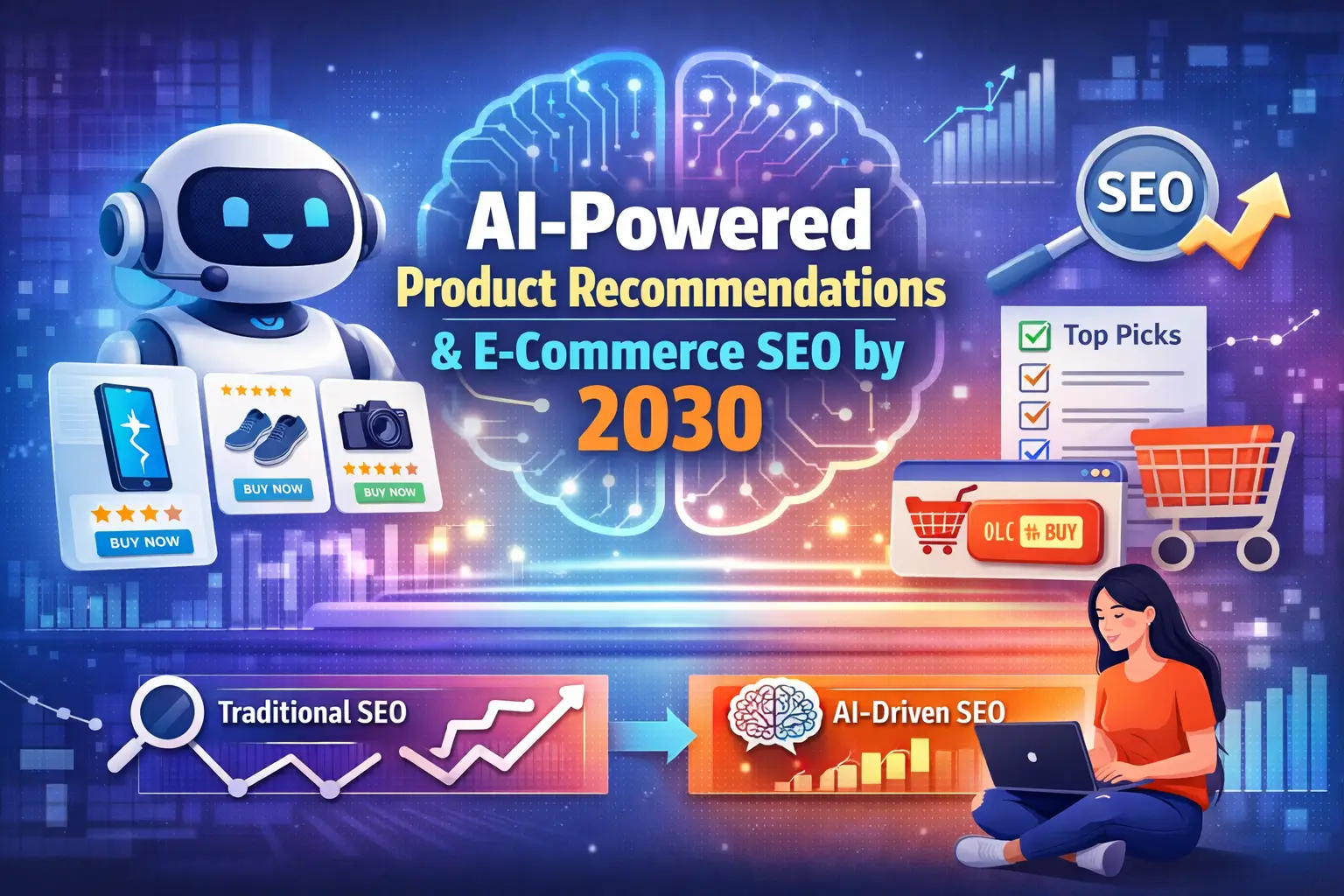
The way people shop online is changing faster than ever. By 2030, AI-powered product recommendations will not just support e-commerce—they will drive it. For businesses and marketers, this shift will completely transform how SEO works. And for students or professionals looking to build a career in this space, understanding these changes is no longer optional.
This blog breaks down how AI recommendations, Large Language Models (LLMs), and smart shopping assistants are reshaping e-commerce SEO—and what skills you need to stay ahead.
The Shift: From Search Engines to AI Shopping Assistants
Traditionally, users searched for products on Google, compared options, and made decisions manually. But AI is eliminating these steps.
What’s changing?
- Users now ask AI assistants: “Best budget smartphone under ₹20,000.”
- AI tools provide ready-made recommendations
- Decisions happen without visiting multiple websites
Result:
SEO is moving from ranking pages to being recommended by AI systems

Don’t Let Marketing Challenges Hold You Back—Get Customized Consulting Solutions Today!
Simplify your marketing efforts and maximize results with guidance from experienced digital marketing professionals.
How AI-Powered Recommendations Work?
AI uses data like:
- User behaviour (clicks, purchases)
- Preferences and browsing patterns
- Product reviews and ratings
- Context (location, time, intent)
Simplified Flow:
| Step | AI Process |
| 1 | Collect user data |
| 2 | Analyse behaviour patterns |
| 3 | Match with the product database |
| 4 | Generate personalised recommendations |
| 5 | Display via an AI assistant |
Impact on E-commerce SEO by 2030
1. Keyword-Based SEO Will Decline
Traditional keyword stuffing will become irrelevant.
AI focuses on:
- Context
- Intent
- Natural language queries
2. Product Data Will Become Critical
Search engines will prioritise:
- Structured data (Schema)
- Product attributes
- Reviews & ratings
3. Content Will Need to Be AI-Friendly
Content must be:
- Clear and structured
- Informative
- Conversational
4. Zero-Click Purchases Will Rise
Users won’t visit websites—they’ll buy directly via AI assistants.
Comparison: Traditional SEO vs AI-Driven SEO
| Factor | Traditional SEO | AI-Driven SEO (2030) |
| Focus | Keywords | User Intent |
| Traffic Source | Search Engines | AI Assistants |
| User Journey | Multi-step | One-step |
| Content Style | Optimised | Conversational |
| Ranking | SERP Position | AI Recommendation |
Role of LLM Shopping Assistants
Large Language Models (LLMs) like ChatGPT or AI shopping bots will become the primary buying interface.
How they replace traditional search:
- Users ask direct questions
- AI compares products instantly
- Recommendations are personalised
- Purchase links are embedded
Example:
Instead of:
Searching “best laptop under ₹50,000.”
Users will:
Ask AI: “Suggest me a laptop for video editing under ₹50,000.”
AI gives:
- Top 3 products
- Pros & cons
- Direct purchase links
Why This Matters for Digital Marketing Students?
If you’re planning a career in digital marketing, this shift is a huge opportunity.
At a professional level, you must learn:
- AI-based SEO strategies
- Data structuring (Schema Markup)
- Content for conversational AI
- Product feed optimisation
This is exactly where digital marketing training programmes play a crucial role—helping learners adapt to real-world changes.
Skills Required for Future SEO Professionals
Core Skills:
- AI SEO optimisation
- Content strategy for LLMs
- Data analytics
- E-commerce understanding
Advanced Skills:
- Prompt engineering
- AI tools handling
- Automation workflows
- Personalisation strategies
Ready to Take App Development to the Next Level? Join Our Flutter Training Program!
Gain in-depth knowledge of Flutter to launch sleek, high-functioning applications efficiently.
How Businesses Should Prepare for 2030?
Immediate Actions:
- Optimise product data
- Improve content quality
- Focus on user intent
Long-Term Strategy:
- Integrate AI tools
- Build structured databases
- Use conversational content formats
E-commerce Strategy Evolution
| Timeline | Strategy Focus |
| 2025 | SEO + Paid Ads |
| 2027 | AI-assisted SEO |
| 2030 | AI-driven recommendations |
Practical Learning Approach (For Students)
To succeed in this field, learning must go beyond theory.
What you should practise:
- Writing AI-friendly content
- Creating product schemas
- Analysing user intent
- Using AI tools like ChatGPT for SEO
Final Thoughts
AI-powered product recommendations are not just a trend—they are the future of e-commerce. By 2030, traditional SEO will evolve into a more intelligent, data-driven, and AI-integrated system.
For students, marketers, and business owners, the message is clear:
Adapt now or fall behind.
If you want to build a future-ready career, joining a Digital Marketing Training Institute in Ahmedabad can give you the right direction, practical exposure, and industry-ready skills needed to thrive in the AI-driven digital landscape.
