
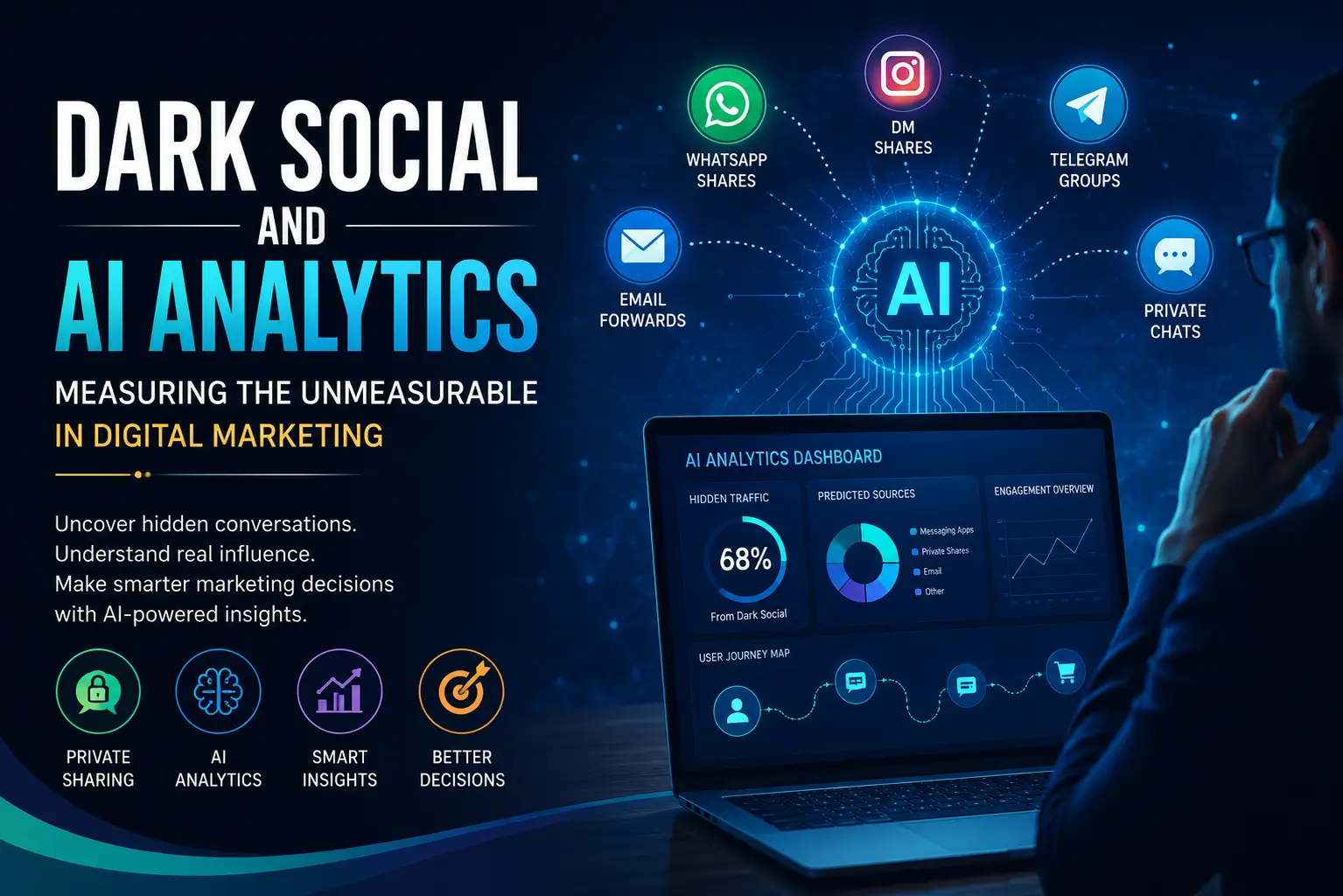
In today’s digital world, marketers rely heavily on analytics dashboards, website traffic reports, and campaign tracking tools to understand customer behaviour. But what if a large percentage of online sharing is happening in places where traditional tracking simply cannot reach?
This hidden layer of online interaction is called Dark Social — a powerful yet often invisible part of digital marketing. From WhatsApp forwards and Instagram DMs to Telegram groups and private Slack channels, users constantly share links and recommendations in private spaces that analytics tools struggle to measure.
For modern marketers, understanding dark social is no longer optional. With the rise of AI-powered analytics, brands are now finding smarter ways to uncover these hidden customer journeys and improve marketing performance.

Want to Decode Data with Ease? Our Expert Training Will Show You How!
Gain essential data skills to identify trends, predict outcomes, and support strategic decisions.
What is Dark Social?
Dark social refers to website traffic and content sharing that occurs through private communication channels rather than public platforms.
Common Examples of Dark Social Channels
| Platform | Type of Sharing | Trackable? |
| Private link sharing | Mostly No | |
| Instagram DMs | Product recommendations | Limited |
| Telegram Groups | Community discussions | Difficult |
| Email Sharing | Direct forwarding | Partial |
| Slack/Discord | Internal conversations | Very Limited |
When a user copies a website link and sends it privately to a friend, analytics platforms often categorise that visit as “Direct Traffic,” even though it actually came from a recommendation.
This creates a major blind spot for marketers.
Why Dark Social Matters in Modern Marketing?
Consumers trust personal recommendations more than advertisements. A product shared by a friend on WhatsApp often converts faster than a paid social media ad.
The Hidden Influence of Dark Social
- High-intent visitors often come from private shares
- Conversion rates from personal recommendations are usually stronger
- Brands lose attribution data without proper tracking
- Customer journeys become incomplete in reports
According to industry studies, a large percentage of content sharing now happens privately rather than publicly. This means marketers who ignore dark social are missing valuable insights into audience behaviour.
The Traditional Analytics Problem
Most tracking systems depend on:
- Cookies
- UTM parameters
- Referral URLs
- Tracking pixels
However, private messaging apps frequently strip or block this data.
Example Scenario
| User Action | What Actually Happened | What Analytics Shows |
| Friend shares product link on WhatsApp | Recommendation traffic | Direct traffic |
| User clicks the shared Instagram DM link | Social influence | Unknown source |
| Email forwarded to colleague | Referral traffic | Direct visit |
As a result, marketing teams struggle to identify:
- Which campaigns truly drive engagement
- Which channels influence conversions
- How users discover their brand
This is where AI analytics enters the picture.
How AI Analytics is Transforming Digital Marketing?
Artificial Intelligence is helping marketers identify hidden patterns that traditional tools cannot detect.
Instead of relying only on direct tracking, AI analyses behavioural signals, predictive patterns, engagement timing, and customer pathways.
AI Analytics Can Help Brands:
✔ Identify probable traffic sources
✔ Analyse customer behaviour patterns
✔ Detect hidden sharing trends
✔ Predict conversion journeys
✔ Improve attribution modelling
AI does not “see” private messages directly, but it helps marketers understand the impact those conversations create.
AI Techniques Used to Measure Dark Social
1. Behavioural Pattern Analysis
AI tools analyse how visitors behave after landing on a website.
For example:
- Time spent on pages
- Navigation flow
- Repeat visits
- Purchase behaviour
If multiple users suddenly visit the same page with similar behaviour patterns, AI can detect a probable private sharing trend.
2. Predictive Attribution Models
Modern AI platforms use machine learning to estimate where traffic is likely coming from.
Instead of saying:
“Source Unknown”
AI can predict:
“High probability this traffic originated from messaging apps.”
This helps marketers make smarter campaign decisions.
3. Natural Language Processing (NLP)
AI-powered social listening tools use NLP to analyse:
- Brand mentions
- Conversation sentiment
- Trending discussions
Even when conversations happen outside public social feeds, AI can sometimes identify patterns through indirect signals.
4. Cross-Device Journey Tracking
Consumers often:
- Discover products on mobile
- Research on the desktop
- Purchase later on another device
AI analytics platforms connect these fragmented touchpoints to build a clearer customer journey map.
Why Must Digital Marketing Students Learn This?
The future of marketing is becoming increasingly data-driven and AI-focused. Businesses now need professionals who understand not just advertising, but also advanced analytics and consumer behaviour tracking.
This is why learning modern analytics strategies through professional digital marketing training has become highly valuable for students, freelancers, and business owners.
Skills related to:
- AI-powered analytics
- Attribution modelling
- Customer journey mapping
- Marketing automation
- Data interpretation
are becoming essential in today’s competitive digital landscape.
Practical Strategies Brands Use to Reduce Dark Social Blind Spots
While dark social cannot be tracked perfectly, marketers can reduce uncertainty using smarter methods.
Effective Techniques Include:
| Strategy | Purpose |
| Share Buttons with Tracking | Encourage measurable sharing |
| Shortened Custom URLs | Better attribution |
| UTM Campaign Parameters | Source identification |
| AI Analytics Platforms | Behaviour prediction |
| First-Party Data Collection | Improved customer insights |
Brands combining AI with first-party data strategies gain a stronger understanding of hidden traffic sources.
Ready to Boost Your Career with AI Skills?
Learn in-demand AI and digital marketing techniques designed to enhance your career growth and open new opportunities.
The Future of AI and Dark Social Measurement
As privacy regulations grow and third-party cookies decline, marketers will depend more on:
- AI-driven attribution
- Predictive analytics
- First-party customer data
- Behavioural intelligence
The future will not focus on tracking every click individually. Instead, it will focus on understanding patterns and customer intent through smarter AI systems.
This shift is already transforming how businesses approach digital marketing campaigns.
Final Thoughts
Dark social represents one of the biggest hidden opportunities in digital marketing today. While private sharing channels may remain partially invisible, AI analytics is helping brands uncover deeper customer insights and make more informed decisions.
For aspiring marketers, understanding dark social, attribution modelling, and AI-powered analytics is becoming increasingly important in the modern business environment. Companies are actively looking for professionals who can interpret hidden data patterns and optimise campaigns beyond traditional tracking methods.
If you want to build future-ready marketing skills and understand advanced concepts like AI analytics, customer behaviour tracking, and attribution modelling, joining a professional Digital Marketing Training Institute in Ahmedabad can help you gain practical industry knowledge and real-world expertise.
