
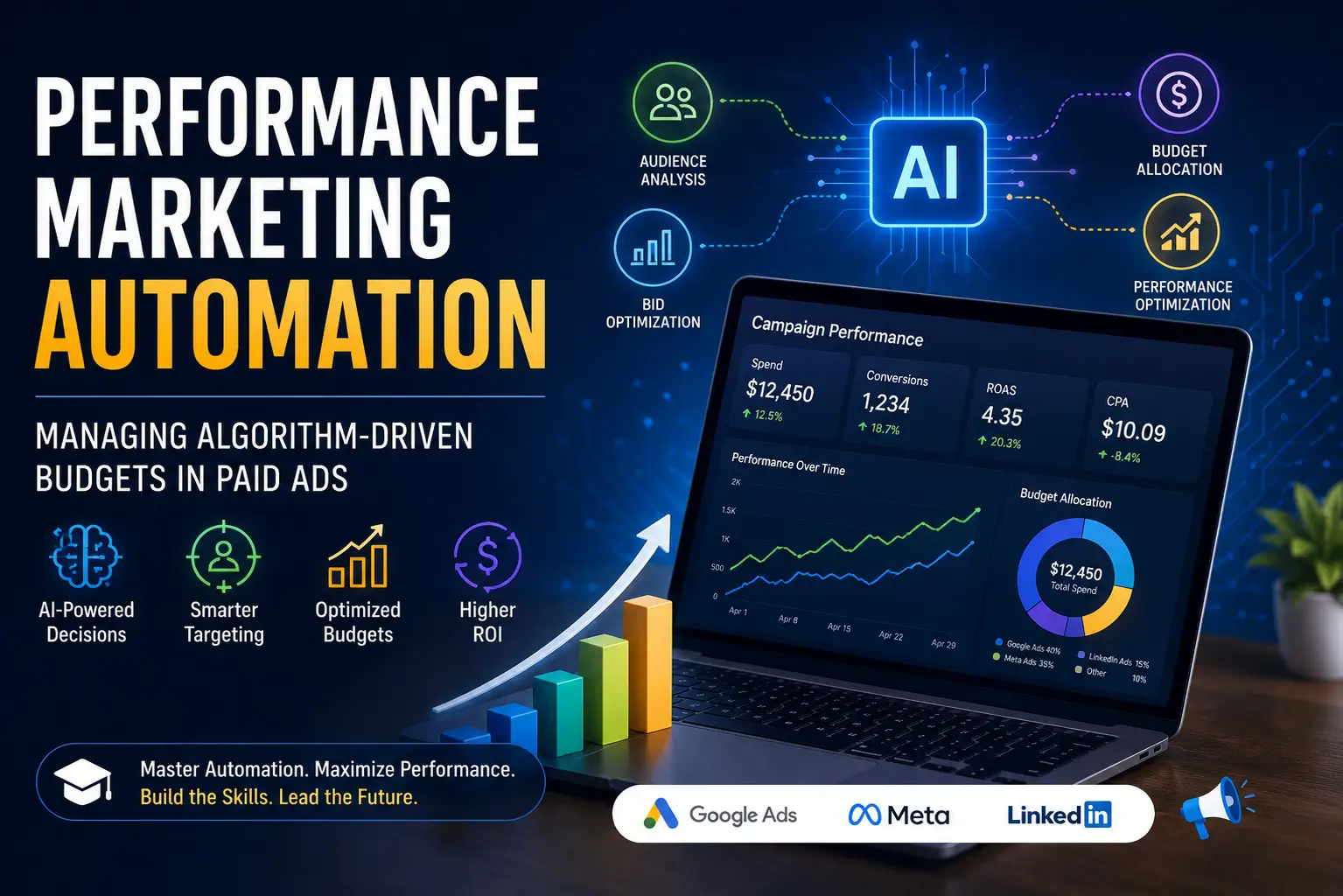
Digital advertising has evolved far beyond manual bidding and basic audience targeting. Today, platforms like Google, Meta, and LinkedIn use advanced algorithms to automatically optimise campaigns, bids, placements, and budgets. This shift has introduced a new era known as Performance Marketing Automation.
For aspiring marketers and business professionals, understanding how algorithm-driven budgets work is now a must-have skill. Companies are increasingly looking for marketers who can guide AI-powered advertising systems instead of manually controlling every setting.
In this blog, we will explore how automation is transforming paid advertising and how learners can build future-ready skills in performance marketing.
What is Performance Marketing Automation?
Performance Marketing Automation refers to the use of AI-driven tools and machine learning algorithms to manage digital advertising campaigns automatically. Instead of adjusting bids manually every hour, platforms now analyse thousands of signals in real-time and optimise campaigns based on goals like:
- Leads
- Sales
- Website traffic
- App installs
- Engagement
- Return on Ad Spend (ROAS)

Struggling to Enhance Your Institution’s Digital Presence? Join Our Tailored Training Programs Today!
Learn expert strategies to strengthen your institution’s online presence and achieve impactful digital marketing results.
Traditional vs Automated Advertising
| Traditional Paid Ads | Automated Paid Ads |
| Manual bidding | Smart bidding |
| Human audience targeting | AI-based audience prediction |
| Fixed budget allocation | Dynamic budget optimisation |
| Limited data analysis | Real-time machine learning |
| Slower optimisation | Faster performance adjustments |
This automation helps advertisers reduce guesswork and improve campaign efficiency.
Why Algorithm-Driven Budgets Matter?
Modern advertising platforms process massive amounts of user behaviour data every second. Algorithms decide:
- Which audience should see the ad
- The best time to display ads
- Which creatives perform better
- How much budget should be spent
- Which placement delivers maximum ROI
This means marketers no longer succeed only through creativity. They also need analytical thinking and automation management skills.
Key Benefits of Performance Marketing Automation
1. Smarter Budget Allocation
AI systems automatically push more budget toward high-performing campaigns and reduce spending on underperforming ads.
2. Faster Decision Making
Algorithms react instantly to market changes, audience behaviour, and conversion trends.
3. Improved ROI
Automated bidding strategies often produce better returns compared to fully manual campaign management.
4. Better Audience Targeting
Platforms use behavioural signals, interests, search intent, and engagement history to identify ideal customers.
5. Time Efficiency
Automation reduces repetitive manual work and allows marketers to focus on strategy and creativity.
Important Metrics Every Learner Should Understand
Even with automation, marketers still need to monitor campaign performance carefully.
| Metric | Purpose |
| CPC (Cost Per Click) | Measures ad click cost |
| CTR (Click Through Rate) | Indicates ad engagement |
| CPA (Cost Per Acquisition) | Tracks conversion cost |
| ROAS | Measures advertising profitability |
| Conversion Rate | Shows landing page effectiveness |
| Impression Share | Tracks visibility against competitors |
Learning these metrics is essential for anyone entering the digital advertising field.
Human Strategy Still Matters
One common misconception is that automation removes the need for marketers. In reality, algorithms perform best when guided by skilled professionals.
A marketer still needs to:
- Create strong ad creatives
- Define campaign goals
- Understand customer psychology
- Structure campaigns properly
- Analyse performance reports
- Improve landing pages
This is why modern digital marketing training programmes now focus heavily on performance marketing platforms, analytics, and AI-driven advertising systems.
Common Challenges in Automated Advertising
Although automation offers many advantages, it also creates new challenges that marketers must learn to handle.
Learning Phase Instability
New campaigns often require time before algorithms optimise properly.
Overdependence on Automation
Blindly trusting AI without monitoring data can lead to budget wastage.
Poor Conversion Tracking
If tracking systems are inaccurate, algorithms optimise for the wrong actions.
Creative Fatigue
Even automated systems need fresh creatives regularly to maintain engagement.
Budget Scaling Issues
Increasing budgets too quickly may negatively impact performance.
Understanding these challenges helps students become smarter advertisers rather than depending completely on automation.
Skills Future Performance Marketers Need
The future of advertising belongs to marketers who can combine creativity with data analysis.
Essential Skills Include:
- Performance marketing strategy
- Google Ads management
- Meta Ads optimisation
- Conversion tracking
- Analytics interpretation
- Audience research
- Funnel building
- Landing page optimisation
- AI-powered campaign management
How AI is Changing Media Buying Careers?
Earlier, advertisers manually controlled most campaign settings. Today, platforms handle many technical processes automatically.
This shift has changed the role of media buyers from:
| Old Role | Modern Role |
| Manual bid adjustments | Strategic campaign planning |
| Basic targeting setup | Data-driven audience analysis |
| Spreadsheet-heavy optimisation | AI-guided decision making |
| Platform operation | Growth-focused marketing |
As automation grows, marketers who understand AI-based advertising systems will have stronger career opportunities across agencies, startups, and brands.
Best Practices for Managing Automated Campaigns
To achieve consistent results with performance marketing automation, learners should follow structured practices.
Ready to elevate your marketing game? Join our expert-led digital marketing courses now!
Transform your career with our comprehensive digital marketing training, covering everything from PPC to email marketing.
Recommended Approach
Before Launch
- Set clear campaign objectives
- Install proper tracking systems
- Define target audiences
- Prepare multiple creatives
During Campaign
- Monitor conversion quality
- Avoid frequent unnecessary edits
- Analyse performance trends
- Compare automated strategies
During Scaling
- Increase budgets gradually
- Test multiple audience segments
- Refresh creatives regularly
- Optimise landing pages
These practices help marketers work alongside algorithms instead of fighting against them.
Conclusion
Performance marketing automation is reshaping the future of paid advertising. Algorithms now handle bidding, targeting, and budget optimisation at a scale humans cannot manage manually. However, successful campaigns still depend on skilled marketers who understand strategy, analytics, audience behaviour, and creative communication.
For students and professionals looking to build a future-ready career, learning how to manage AI-driven advertising systems is becoming increasingly important. The demand for trained performance marketers continues to rise as businesses invest more heavily in digital advertising.
Joining a professional Digital Marketing Training Institute in Ahmedabad can help learners gain practical exposure to automation tools, paid advertising platforms, campaign strategies, and real-world media buying techniques required in today’s competitive market.
